
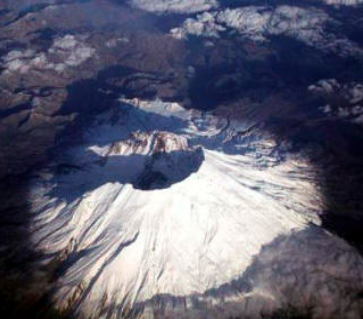
This is one volcano that I’ve visited quite often. It has grown into my favorite place to go, actually. I’ve watched many sunrises from the Coldwater Ridge and Loowit overlooks. There’s just something about starting out a day on the peaceful slopes of “The Mountain”.
I go to Mt St Helens quite a bit, and in 2003, I put together this overview of the event that shaped the region, changing it forever.
Over the years
A bit more detail of the history of The Mountain, and the eruption that played a major role in why I live here in the Pacific Northwest.
Visits to the Mountain
Picture essays of trips to The Mountain where I’ve brought my camera with me, and remembered to take pictures.
A bit about Mt St Helens
Mt St Helens is quite active, and has been for quite some time. In recent history… It had just erupted when Lewis and Clark came through, and not long after settlers came to Oregon Territory, it spouted again, and continued off and on until 1857. Then, in 1980, it woke up in a famously big way. Dome building stopped completely in 1992. Thousands of earthquakes in 1998 seems to have been movement of magma, but the ‘plug’ held, and no material was released. Another eruption occurred in 2004, and after that the Dome Building has resumed… at the incredible early rate of 7 cubic yards per second – a dump truck every 3 seconds! It slowed to an average of .14 cubic yards a second, which ended up being about 4 Olympic-Sized swimming pools a day. The new lava dome grew to be more than 130 million cubic yards (which would fill more than 200 large sports stadiums) The growth continued through 2007, and stopped in February 2008.
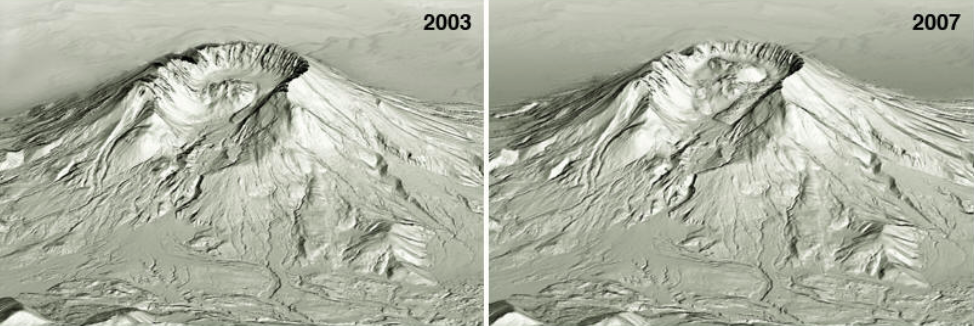
The differences during the latest dome building eruption are quite visible… one effect being the glacier that was in the crater was squeezed out, and was turned into the fastest advancing glacier in the US.
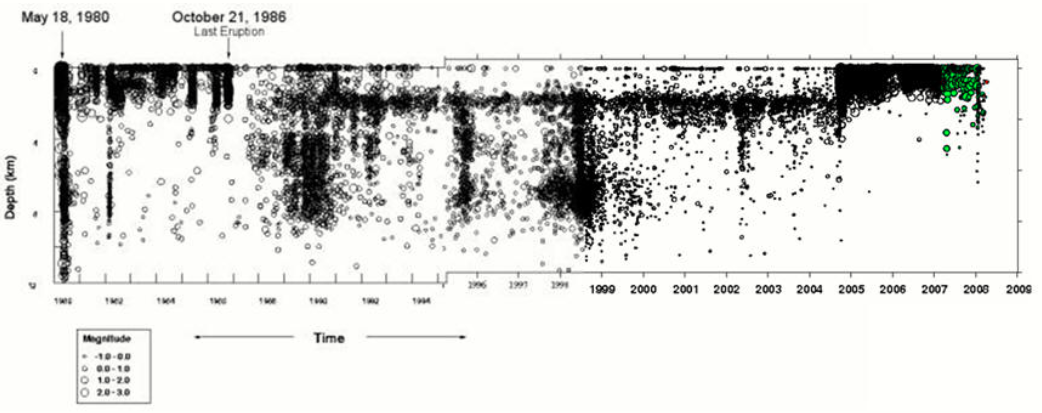
Here’s the time and depth location chart for Mt St Helens… I’ve pasted several together, to get a longer chain of events… its pretty impressive to see how active its been over the years!
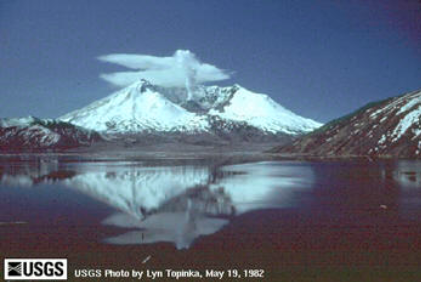
Facts and Figures
Mount St. Helens (2,549 meters – 8,364 feet ((9,677 feet before May 18, 1980))
Location: Washington
Latitude: 46.20 N
Longitude: 122.18 W
Height: 2,549 Meters (8,364 feet (9,677 feet before May 18, 1980))
Type: Stratovolcano
Latest Eruptions: Between 1600 and 1700; about 1800-1802; 1831; 1835; 1842-44(?); about 1847-1854; 1857; 1980, 1986, 2004-?
Present thermal activity: Extrusion of Volcanic Rock – Primarily Dacite
Remarks: Continuous volcanic activity since October 2004… Occasional eruptions of steam and ash; steady extrusion of dome-forming lava.
Situated in southwestern Washington about 50 miles northeast of Portland, Oregon, Mt St Helens is one of several lofty volcanic peaks that dominate the Cascade Range of the Pacific Northwest. Geologists call Mount St. Helens a composite volcano (or stratovolcano), a term for steep-sided, often symmetrical cones constructed of alternating layers of lava flows, ash, and other volcanic debris. Composite volcanoes tend to erupt explosively and pose considerable danger to nearby life and property. In contrast, the gently sloping shield volcanoes, such as those in Hawaii, typically erupt nonexplosively, producing fluid lavas that can flow great distances from the active vents. Although Hawaiian-type eruptions may destroy property, they rarely cause death or injury. Before 1980, snow-capped, gracefully symmetrical Mount St. Helens was known as the “Fujiyama of America.” Mount St. Helens, other active Cascade volcanoes, and those of Alaska comprise the North American segment of the circum-Pacific “Ring of Fire,” a notorious zone that produces frequent, often destructive, earthquake and volcanic activity
Some Indians of the Pacific Northwest variously called Mount St. Helens “Louwala-Clough,” or “smoking mountain.” The modern name, Mount St. Helens, was given to the volcanic peak in 1792 by Captain George Vancouver of the British Royal Navy, a seafarer and explorer. He named it in honor of a fellow countryman, Alleyne Fitzherbert, who held the title Baron St. Helens and who was at the time the British Ambassador to Spain. Vancouver also named three other volcanoes in the Cascades- Mounts Baker, Hood, and Rainier-for British naval officers.
Frequent dacitic eruptions during the previous 2,500 years had produced pyroclstic flows, ash falls, debris flows, lava domes, and lava flows of andesite and basalt. Pyroclastic flows and lahars accompanied most eruptive periods and were largely responsible for forming fans around the base of the volcano, some of which dammed the North Fork Toutle River to form Spirit Lake between 3,300 and 4,000 years ago. The magnitudes of the 1980 eruptions were not exceptional by worldwide historical standards; however, they were the first volcanic eruptions in the conterminous United States since 1914 (Lassen Peak) and focused national attention on events leading up to the climactic eruption of May 18, 1980. That eruption led to exceptional opportunities for scientific observations, data collection, and the study of infrequent and often inaccessible geologic events and processes.
 Our Northwest Family