
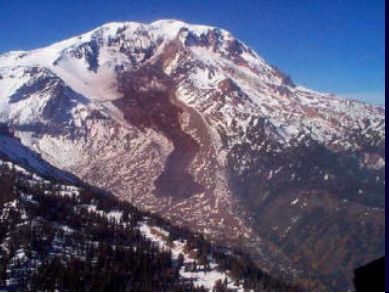
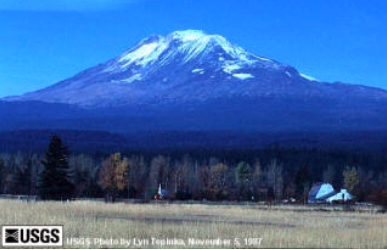
Mount Adams stands astride the Cascade Crest some 50 kilometers due east of Mount St. Helens. The towering stratovolcano (3,742 Meters – 12,276 Feet) is marked by a dozen glaciers, most of which are fed radially from its summit icecap. In the High Cascades, Mount Adams is second in eruptive volume only to Mount Shasta, and it far surpasses its loftier neighbor Mount Rainier (which is perched on a pedestal of Miocene granodiorite). Adams’s main cone exceeds 200 cubic kilometers, and at least half as much more was eroded during late Pleistocene time form earlier high-standing components of the compund edifice: peripheral basalt adds another 70 cubic kilometers or so.
During its past, numerous volcanic vents were active throughout south-central Washington, from Vancouver to Goldendale. Most were probably active for relatively short times ranging from days to tens of years. Unlike Mount Adams, which has erupted repeatedly for thousands of years, these vents typically did not erupt more than once. Rather, each erupting vent built a separate, small volcano, and over time a field of numerous overlapping volcanoes was created. Clusters of these vents define the Mount Adams, Indian Heaven, and Simcoe Mountains volcanic fields. In addition, the Goat Rocks volcanic center lies 30 kilometers (18 miles) north of Mount Adams. The Mount Adams and Indian Heaven fields have been the most active recently; the Simcoe field and the Goat Rocks center have not erupted for hundreds of thousands of years.
Location: Washington
Latitude: 46.206 N
Longitude: 121.49 W
Height: 3,742 Meters (12,276 Feet)
Type: Stratovolcano
Latest Eruptions: More than 3,500 years ago.
Present thermal activity: Fumaroles emitting steam and hydrogen sulfide in the crater area.
Remarks: Debris flows are latest events… Appears to consist of a group of several superimposed volcanic cones. Summit crater has extensive sulfur deposits that were formerly mined.
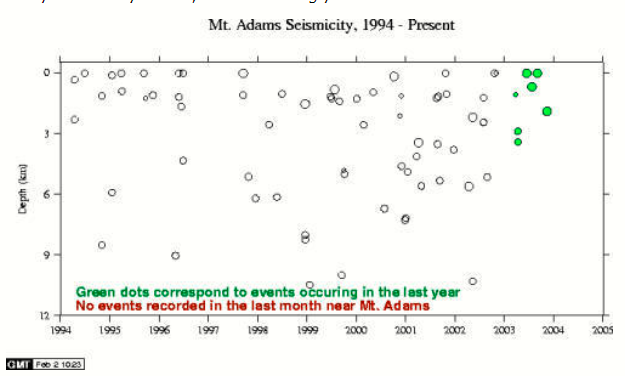
Seismic Activity: Not very active, but increasingly busier
 Our Northwest Family