
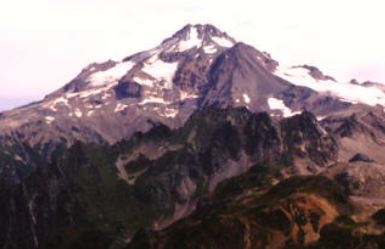
Glacier Peak (3,213 meters) is a small Cascade Range stratovolcano. Although its summit reaches greater then 3,000 meters above the surrounding valleys, the main cone of Glacier Peak is perched on a high ridge, and the volcanic pile is no more than 500-1,000 meters thick. More than a dozen glaciers occur on the flanks of the volcano, and unconsolidated pyroclastic deposits over 12,000 years old have been largely removed by glaciation. Lava flows locally cap ridges to the northeast of the volcano, indicating a topographic reversal, and glacial and fluvial downcutting of more than 2,000 meters has occurred since the earliest cone-building eruptions. While small basaltic flows and cones are found at several points around the flanks of Glacier Peak, the main edifice is largely dacite and andesite. Lava flows extend no more than a few kilometers from the summit.
Location: Washington
Latitude: 48.112 N
Longitude: 121.113 W
Height: 3,213 Meters (10,541 Feet)
Type: Stratovolcano
Latest Eruptions: About 200-300 years ago; 1,000-1,800 years ago; 1,800-2,800 years ago..
Present thermal activity: Two hot springs on the volcano’s lower flanks.
Remarks: Eruptions have characteristically produced large volumes of volcanic ash and airborne pumice that could endanger closest centers of population 3.
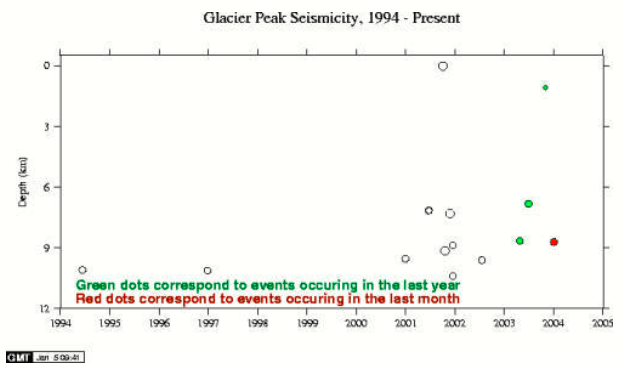
Seismic Activity: Slight, but increasing
Eruptive History
Glacier Peak is a small Cascade Range stratovolcano. Although its summit reaches greater then 3,000 meters above the surrounding valleys, the main cone of Glacier Peak is perched on a high ridge, and the volcanic pile is no more than 500-1,000 meters thick. More than a dozen glaciers occur on the flanks of the volcano, and unconsolidated pyroclastic deposits over 12,000 years old have been largely removed by glaciation.
Lava flows locally cap ridges to the northeast of the volcano. While small basaltic flows and cones are found at several points around the flanks of Glacier Peak, the main edifice is largely dacite and andesite. Lava flows extend no more than a few kilometers from the summit. Glacier Peak is probably best known as the source of voluminous tephra eruptions dated to 11,250 years BP. Two tephra layers produced at this time have been identified as far as 800-1,000 kilometers to the east, and are widely used by geologists, anthropologists, and paleoecologists to date late Pleistocene sediments. Also at this time, an extensive valley fill of pumiceous lahars and alluvium was deposited downriver to the west, blocking valleys and affecting drainages as far as 80 kilometers from the volcano.
After these major eruptions, Glacier Peak apparently was dormant for 6,000 years. The volcano rewoke 5,500-5,100 years B.P. and intermittent eruptions of pyroclastic flows and tephra have occurred since that time. perhaps the most dramatic geologic features at Glacier Peak are enormous and relatively undissected late Pleistocene and Holocene pyroclastic fans which almost completely fill valleys on the eastern and western flanks of the volcano.
18th Century Indian legends and a thin tephra fall preserved east of the volcano may record a recent eruption in the 18th century, although no eruptive activity has occurred during at least the last 150 years.
Hot Springs and Dacite Domes
Three hot springs surround the volcano, and warm ground and snow-free areas occur near fresh-appearing dacite domes which form subsidiary summits both north and south of the ice-covered main summit.
 Our Northwest Family