
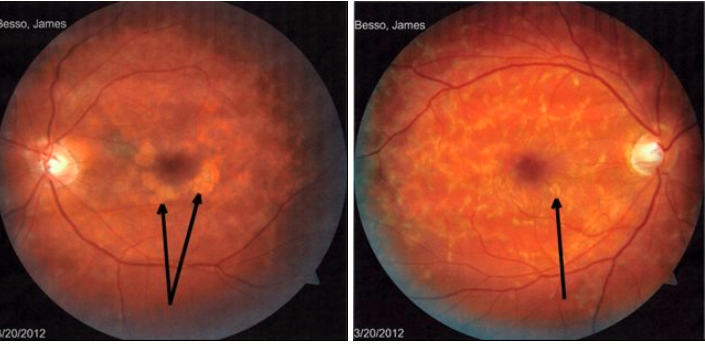
I have Stargardt’s Disease. (By “I,” I’m referring to Jim, aka Dad) Stargardt’s is the common name for “Fundus Flavimaculatus “, which is a genetic condition affecting vision by eroding the macular, the high-vision center of the eye. Basically, it is a cousin of RP, or ” Retinitis Pigmentosa “, which is a more known eye condition. Where RP causes vision loss from the edges in, SD erodes from the middle out.
It has no cure, no treatment, and ends in blindness for those affected.
You’re going BLIND?
Eventually, unfortunately, yes. Now you know why I hold my phone so close to my face, wear sunglasses even when indoors, and have trouble reading. Stargardt’s effects happen somewhat slowly, but it progresses steadily towards blindness. Eventually, I will be blind. But… I’m hoping it takes a while. Everyone’s experience is different, but eventually, we end up in the same general place. It was in 2009 that the first symptoms were noticed, and after a couple of years, I started noticing artifacts in my vision. These artifacts (blinking lights, distorted spots, then blind spots, which have slowly gotten larger more numerous, and merging together, which makes them increasingly bothersome for my vision.
Stargardt’s?
Stargardt’s is known as Stargardt macular dystrophy, or Juvenile Macular Degeneration, or, officially, Fundus Flavimaculatus. It causes degeneration in the macula, which is the central vision portion of the retina that enables sharp, straight-ahead vision that is used when you read, or look right at something or someone. Stargardt’s is part of a family of genetic disorders that cause the retina to die. About one lucky person in 10,000 have the disease.
How fast will your vision fade?
It is a different experience for everyone, but the loss of central vision is Stargart’s calling card. The affected person’s central vision will typically erode fairly quickly (3-5 years) to about 20/200 (legal blindness), then continue to erode to 20/400. 20/200 means that what an average person will see at 200 feet, an affected person will see at 20 feet. Eventually, the affected region will expand into the peripheral vision field to a point where the individual is effectively functionally blind, but progression to that point typically takes several decades.
Is that why you wear sunglasses?
Literally seeing causes me to go blind. Wearing sunglasses slows that process. Also, bright light physically hurts my eyes. The light level in a normally-lighted room is painful, and causes headaches after a short time. I wear a hat to help protect me from the lights, and sunglasses to reduce the overall light level entering the eye.
HOW does Stargardt’s cause blindness?
When the retina translates light to the electro-chemical signal sent to the brain by the optic nerve, a waste product is produced. This waste product is absorbed by Vitamin A, forming a fatty globule. This globule is normally carried out of the eye as a waste product. With Stargardt’s, the protein needed to remove the Vitamin A by-product is not produced, and instead of being removed, the globules assemble into yellowish clumps called lipofuscin. These clumps are toxic to the cells of the retina, and eventually kill them. As the photo-receptive cells die, vision is impaired.
So what can you see?
Less than I’m willing to admit, most likely. My Central vision fades into a gray fog. On a piece of paper at normal reading distance, it seems about the size of a chocolate chip cookie. I see by concentrating on the edge of the foggy area, only if I move my eyes, the fog moves with it. To get an idea of what I have to do, put a cookie on something you’re reading, and read, while looking at the center of the cookie. Yeah… its not very fun.

When I look across the room, the spot stays the same size. Thankfully, it is not a “cone”, where the blind spot gets bigger the farther away an object is. Hold the cookie at arms length, and you’ll get an idea of how big the spot is when I’m looking at distance. Around the edges of the spot, the foggy area thins out, but the view seems to warp and distort the view as it fades into gray. I cannot see what I am directly looking at, so if I make eye contact, it is because I have guessed where your eyes are. At arm’s length, to see your right eye, I have to look at your left eye. If I’m looking at your year, its because I really want to see your whole face.
Unless I am thinking about it, my mind ignores the gray area. When something goes into the blind spot, it simply disappears, and then reappears when it comes out of the spot. That’s what makes catching a baseball so difficult; the baseball seems to flash while it is coming closer. The blinking effect happens because the brain “fills in” the gaps in the vision. Everyone has a blind spot, where the optic nerve is. We don’t see the spot, because the mind is used to filling in the space with what is around it. In a normal eye, this spot is off to the side of the central vision, so it is largely unnoticed. When it is in the center of the vision field, though, it gets interesting. A head will often disappear, and I see the wall behind it, leaving a headless person talking to me.
How did you get it?
Don’t worry… its not something you can catch. It is a mutation of the ABC4 gene that controls protien production in your eye. The protien I need to remove the waste product generated by seeing is not being produced, so that waste instead builds up on my retina. It is toxic to the cells on the retina, and as they die, they blink, then cause a grayed area to develop as the dead region gows.
Is there a cure?
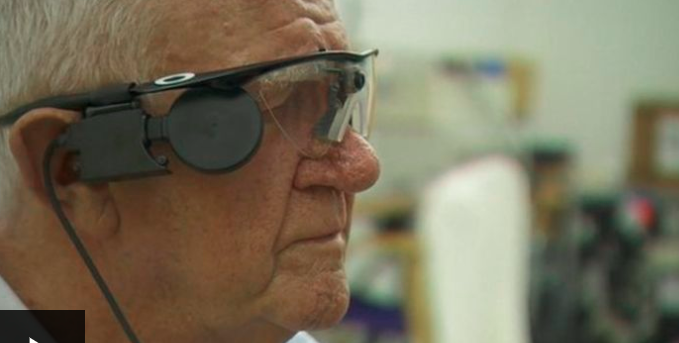
There currently is no cure. There also isn’t really a treatment. I can limit the intake of Vitamin A, but since we need Vitamin A, I obviously have to have some. There have been promising developments recently in both gene therapy and with a medication that helps remove the waste product from the retina, but those are still being tested. There are also devices being developed to help mitigate the loss of sight. The Argus II, for instance, is a small camera mounted on the retina that sends signals down the optic nerve, providing some level of sight. These products continue to improve.
In the meantime, creative use of my phone’s camera helps me read small print. I can take a picture, and zoom in to make it easier to read. I also do most of my reading on Amazon’s Kindle App, or some other electronic book media like WordSearchBible Software, and Logos.
Will stronger glasses help?
Not really. Think of it like a digital camera. If the CCD is damaged, and you have dead spots on the sensor, which creates black spots on your pictures, a better lens isn’t going to improve things much. The spots on the CCD are still not working, and will still leave artifacts on the picture. A damaged retina works pretty much the same way, once the cells die, the clarity of the image hitting them doesn’t matter, they still won’t work. Unfortunately, in the eye, the center vision is the only region where a person can see 20/20. The regions around the center see increasingly less sharp, because there are less cells per square millimeter. I’m already at hte point where glasses can’t correct my vision beyond 20/50 or so. As the spot gets bigger, that number will get worse and worse. Making things bigger makes them easier to see outside the foggy area, so that helps some, but percision seeing is still difficult.
Where can I get more info?
I’m hoping to add more links and the like to this section… all in good time, I guess. There’s not a lot of information out there, sadly enough. For now, these guys ( https://www.allaboutvision.com/conditions/stargardts.htm ) are a good place to start.
 Our Northwest Family