
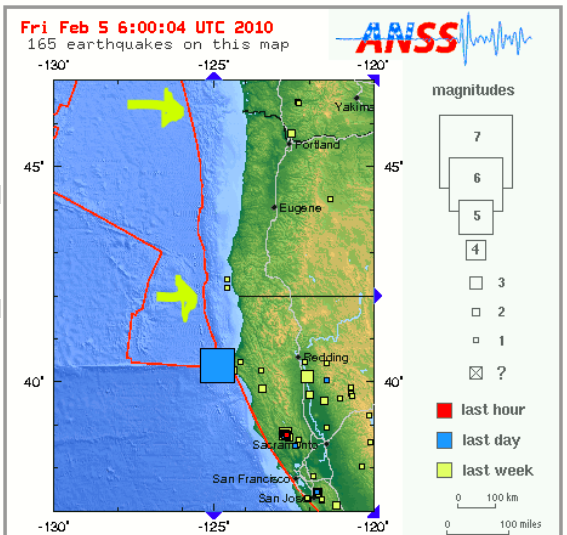
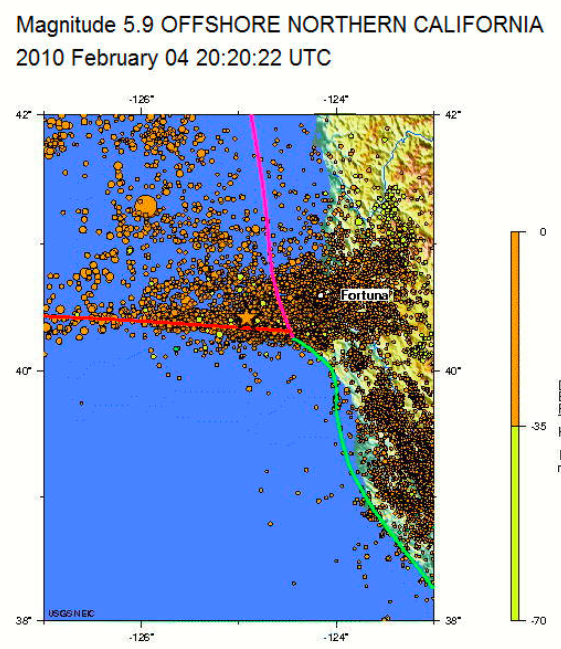
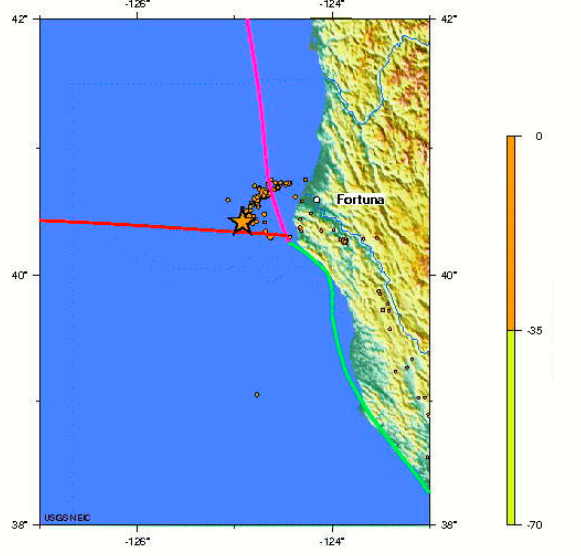
For the second time this month, a large quake happened at the southeastern corner of the Juan de Fuca plate, where the Mendicino Rift, the southern edge of the plate meets the rift that to the south forms the San Andreas Fault and to the north forms the Juan de Fuca Subduction Zone.
It is the Subduction Zone (Yellow arrows) that is ripe for the “250 year period earthquake” that in 1700 ripped, sending a devastating tsunami across the Pacific, and striking Japan, causing thousands of deaths… it also caused major problems in the Pacific North West, causing some native villages to be suddenly more than a mile inland in some places — or more than a mile out to sea in others. More than 50 years later, when the first Europeans made contact with them, they were still talking about it… its also more than 60 years ‘overdue’.
The zone is very similar to the one in Thailand that spawned the tsunami there, and to the one in Chile that was so strong (9.7+) that the sensors on Mt St Helens detected it… and then again when it made its way around the globe to pass by again.
Steve Walter, a seismologist at the USGS in Menlo Park, said Thursday’s quake was not an aftershock because it occurred on a different fault, but “we could speculate it might have been triggered by the one last month.”
When one area of the fault slips, it causes pressure on the other portions… eventually, one of them at either end of the fault line will cause a cascading ‘rip’ along the fault line, which will be felt as a 9+ quake that will shake for several minutes
More maps and info:
AP Story about the quake:
2nd large quake in month hits off N. Calif coast
by Associated Press
Posted on February 4, 2010 at 9:36 PM
Orig. story: http://www.nwcn.com/news/2nd-large-quake-in-month-hits-off-N-Calif-coast-83613707.html
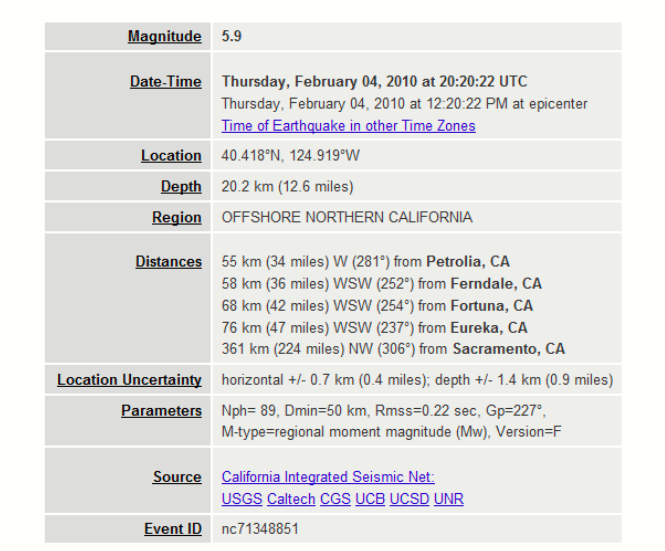
SAN FRANCISCO – Residents of Northern California’s Humboldt County were rocked by a magnitude-5.9 earthquake Thursday, but officials said there were no immediate reports of major injury or damage from the second large temblor to hit the area within a month.
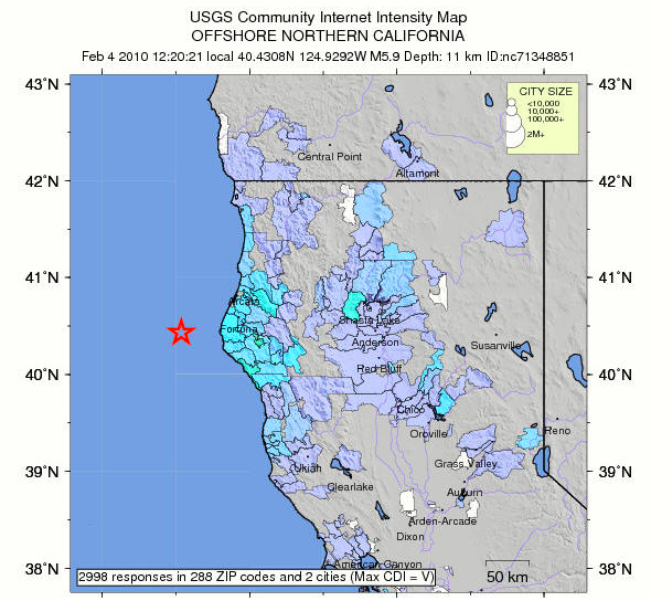
The U.S. Geological Survey reported the quake struck at 12:20 p.m. about 35 miles northwest of the community of Petrolia and nearly 50 miles west of Eureka. The shaking was felt within a 150-mile radius, as far north as southern Oregon and as far south as Sonoma County, according to the USGS Web site.
Local officials and residents reported feeling a rolling sensation that caused items to fall from walls and shelves. Many said the movement didn’t feel nearly as severe as the magnitude-6.5 quake that struck the same region Jan. 9 and caused more than $40 million in damage and one serious injury — an elderly woman who fell and broke her hip.
Eureka Fire Chief Eric Smith said crews were checking on structures that were damaged in the previous earthquake to make sure they’re secure.
Phil Smith-Hanes, the county spokesman, said its Office of Emergency Services had not received any reports of major damage or injuries. “At first blush, it doesn’t look like it’s a big deal,” he said.
Humboldt County Sheriff’s Office spokeswoman Brenda Godsey, who was in a restaurant at the time, said the quake lasted 25 to 30 seconds, with none of the violent jolts felt last month.
“Everybody was very calm and just sort of waited it out,” she said, adding that sheriff’s dispatchers received no significant calls.
At the Petrolia General Store, a box of cereal and some sardine cans tumbled from the shelves, but the windows remained intact.
“Glass bottles were rattling, and you could see the lights swinging back and forth,” said Amie Barr, 30, a store employee. “But it didn’t feel as strong (as the Jan. 9 quake).”
She added, “We have them all the time, so we’re pretty used to it here.”
Steve Walter, a seismologist at the USGS in Menlo Park, said Thursday’s quake was not an aftershock because it occurred on a different fault, but “we could speculate it might have been triggered by the one last month.”
The temblor — initially reported by the USGS as magnitude-6.0 but later revised to magnitude-5.9 — did not trigger any tsunami warnings.
The USGS said it was studying Thursday’s quake and expected to be able to determine in a few days if it was an aftershock to the stronger quake from last month.
Walter said the far-northern coast of California is the most seismically active area in the state, but the potential for damage and injuries there is smaller because it’s less populated.
“They get more earthquakes and much bigger quakes up there,” he said. “They have had more in the past, and they will have more in the future than any other part of California.”
 Our Northwest Family