
One of the arguments the folks who are convinced the NASA Apollo missions were faked is that there are no stars in the pictures, because if there were, then we’d be able to use them to prove that they were taken from Earth, using Parallax, and positioning equipment to triangulate the positioning of the stars…
But, it seems that this argument falls apart… there ARE stars in some of of the pictures… and not in others…
This is an image of Atlantis docked with Mir, taken by an approaching Soyuz spacecraft… NO STARS, yet, we clearly know that the Shuttle reaches orbit – we can see it from the Earth.
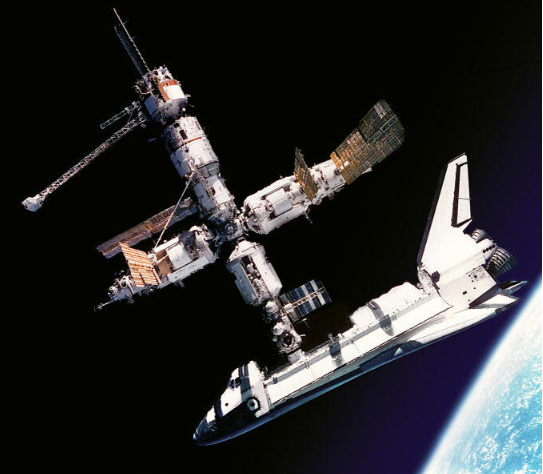
Its a known fact that if you don’t leave a shutter open long enough, then you can’t see dimly lit objects… the white spacecraft and sun-lit surface of the Earth is just too bright to allow the relatively dim light from the stars to make an imprint on the receptor.
The same would apply here… the shutter speed is too quick to allow the stars to show up.
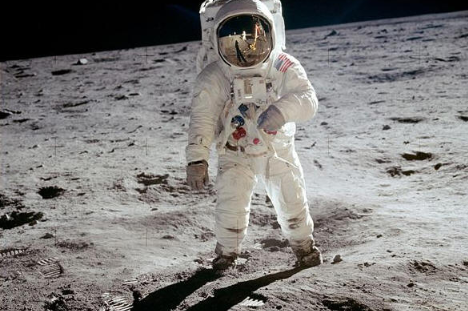
Payload restrictions made the transport of telescope facilities to the Moon unfeasible, and without these ordinary stellar photography would have served no (scientific) purpose. However, even without such facilities, the Moon does offer several advantages as an observation platform. The near-absence of an atmosphere means that stellar imaging is possible at many wavelengths which are not visible from Earth. Long-exposure photos were taken with a special far-ultraviolet camera by Apollo 16 astronauts on April 21, 1972 from the surface of the Moon.

Here are some that have been identified… and yes, they are in the appropriate locations for having been photographed from the surface of the moon.

Though stars would not normally be visible to the naked eye during daylight, whether from the Earth, the Moon, or on orbit, the planet Venus (which is much brighter than any of the stars) was actually recorded on film by astronaut Alan Shepard at the conclusion of his second extravehicular activity, during the Apollo 14 mission. Shepard was preparing to ascend the ladder to re-enter the lunar module Antares, when he likely noticed Venus shining brightly next to the crescent Earth. He made a series of photographs with his chest-mounted Hasselblad camera, likely all at 1/250th second exposure, and differing f-stops. Owing to its position closer to the Sun and its complete coverage by clouds, Venus has a higher surface brightness than Earth, and is indeed visible to the unaided eye in broad daylight from Earth, given a sufficiently transparent sky.
Here’s the picture that Shepard took:

Here is the same image, and the next one on the roll, taken with a slightly different bracketing, showing the location of Earth, and Venus. The gain has been turned way up.
This was a prepared photo from a website I got the information from… so I went to the NASA gallery, and go the image, and tweaked it myself, to see what I would find…

And, if you’re wondering, yep, Venus is where everyone expected it to be… it seems to put a kink in the notion that NASA blocked out the stars.

 Our Northwest Family